Aumento de inicialização da CPU do GKE: acelere a inicialização de aplicativos sem provisionamento excessivo
Story summary
Esteja você lançando microsserviços em resposta a picos repentinos de tráfego, implantando novas versões de software ou ampliando réplicas de aplicativos, o tempo de inicialização do pod é fundamental para manter uma experiência de usuário rápida e responsiva para aplicativos executados no Google Kubernetes Engine (GKE). No entanto, a plataforma e
📌 Key Highlights & Takeaways
- Esteja você lançando microsserviços em resposta a picos repentinos de tráfego, implantando novas versões de software ou ampliando réplicas de aplicativos, o tempo de inicialização do pod é fundamental para manter uma experiência de usuário rápida e responsiva para aplicativos executados no Google Kubernetes Engine (GKE).
- No entanto, a plataforma e
Whether you’re launching microservices in response to sudden traffic spikes, deploying new software releases, or scaling up application replicas, pod startup time is critical to maintaining a fast, responsive user experience for applications running on Google Kubernetes Engine (GKE).
Yet, platform engineers and developers face a persistent dilemma: Applications often demand significantly more CPU power during startup than they do during steady-state operations. Sizing CPU requests for normal, steady-state usage leads to CPU throttling during launch, which can result in sluggish cold starts and readiness probe timeouts. On the flip side, over-provisioning baseline CPU requests to satisfy short-lived startup bursts wastes valuable compute resources, inflating infrastructure bills.
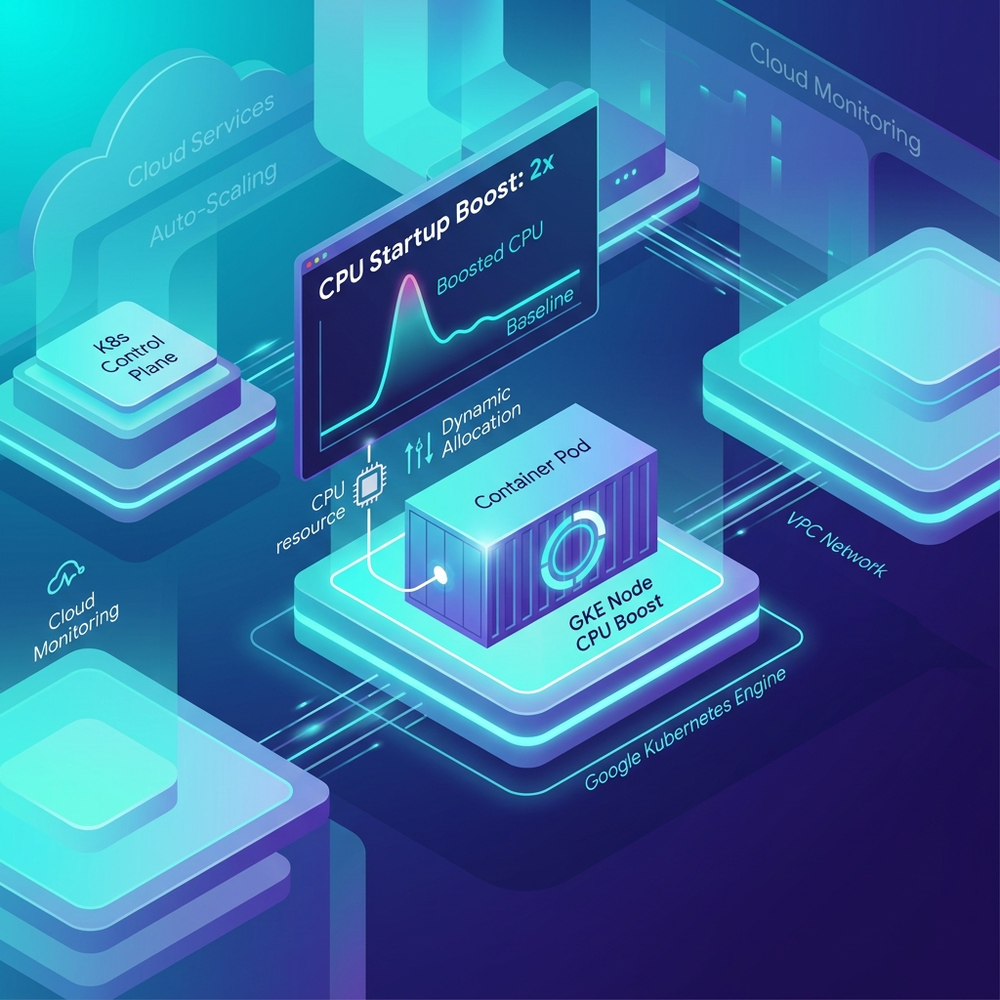
Today, we are excited to announce CPU startup boost for GKE in preview. Integrated directly into GKE's Vertical Pod Autoscaler (VPA), CPU startup boost dynamically elevates a container's CPU allocation during initialization and seamlessly scales it back to baseline steady-state levels once the application is ready - all without restarting your containers.
When a new container launches, it may perform intensive initialization tasks before it begins serving user requests. Depending on your tech stack, the following startup workloads require substantial CPU cycles:
Java JVM applications : Frameworks like Spring Boot require high CPU burst capacity for class loading, classpath scanning, instantiating dependency injection containers, and running Just-in-Time (JIT) compilation.
Node.js servers : Apps parse JavaScript files, build complex module dependency trees ( require / import ), and execute V8 engine optimization and JIT compilation passes during initial execution.
Python and AI/ML microservices : These services spend initial cycles importing heavy libraries (such as PyTorch, NumPy, or LangChain), compiling .pyc bytecode, establishing ORM database schemas, and pre-loading cache structures.
If you size CPU requests strictly for steady-state performance, these initialization workloads experience CPU throttling on launch, delaying readiness probes. To prevent slow cold starts, teams frequently overprovision CPU requests. However, once the application stabilizes, those extra CPU resources sit idle, increasing your cloud spend without adding value.
Cryptographic Security & Key Generator
Generate entropy-tested high-security keys and encryption-grade tokens.
Source: Cloud Blog.
Read the full story at the original source ↗
For questions: mrsmithcons@gmail.com.
☁️ Complete Cloud Credit Application Guide & Architecture Specs
Direct application templates, fast-track partner codes, and architecture benchmarks.
⚡ Access Cloud Playbook ➔More from FreeSky Cloud


 🤖 WinBar AI
Gen Z is betting on AI skills to boost earning power
Breaking coverage reported by Reuters: Gen Z is betting on AI skills to boost earning power. Our news desk tra...
Inside Soitec, the French tech company powering the global semiconductor industry
Inside Soitec, the French tech company powering the global semiconductor industry From smartphones to data cen...
 📦 Free2Rich Vault
Startup chinesa lança software livre de código aberto DeepSeek, alternativa às ferramentas Nividia
Cobertura de última hora relatada por BizzBuzz: Startup chinesa lança software livre de código aberto DeepSeek...
Ukraine says Russian drones kill 14, hit Kyiv and Odesa infrastructure
Ukraine says Russian drones kill 14, hit Kyiv and Odesa infrastructure Ukraine reports 14 dead and 57 injured ...