One Agent Development Kit, five languages
Story summary
When we talk about agents, that doesn't necessarily mean we're talking about Python. In today's modern ecosystem, an agent might run as a high-concurrency Go microservice on Cloud Run, or live inside a browser tab calling Chrome's on-device model. Yet many agent frameworks assume a Python-only stack
📌 Key Highlights & Takeaways
- When we talk about agents, that doesn't necessarily mean we're talking about Python.
- In today's modern ecosystem, an agent might run as a high-concurrency Go microservice on Cloud Run, or live inside a browser tab calling Chrome's on-device model.
- Yet many agent frameworks assume a Python-only stack
When we talk about agents, that doesn't necessarily mean we're talking about Python. In today's modern ecosystem, an agent might run as a high-concurrency Go microservice on Cloud Run , or live inside a browser tab calling Chrome's on-device model. Yet many agent frameworks assume a Python-only stack. That assumption forces teams to either spin up a Python service just for their agent workloads, or to build agent orchestration logic from scratch in their own language.
Google's Agent Development Kit (ADK) removes that trade-off with coverage for Python , Go , TypeScript , Java , and Kotlin . Each version of the ADK is built from the ground up for its own runtime and type system, while sharing a unified architecture with interoperability through open protocols.
Picking a language doesn't lock in your architecture: all five support the same open protocols. ADK includes a Model Context Protocol client in every language, so a custom tool exposed as an MCP server can be called from any of them immediately.
For multi-agent systems, ADK supports the Agent2Agent (A2A) protocol, allowing an agent to communicate with a remote agent over HTTP. Through A2A, agents written in different languages or frameworks are interoperable.
To get started, run the one-time setup command to check your Google Cloud authentication, install the CLI, and then set up first-party ADK skills in coding agents like Antigravity , Claude Code , or Codex :
Then, run the scaffold command to generate a working project with A2A endpoints and deployment config for Cloud Run, Gemini Enterprise Agent Runtime , or Google Kubernetes Engine (GKE) :
Both the ADK for Python and ADK for Kotlin repositories also ship agent builder skills in their source trees, and the adk.dev/llms.txt resource gives any coding agent on-demand API documentation across all five languages.
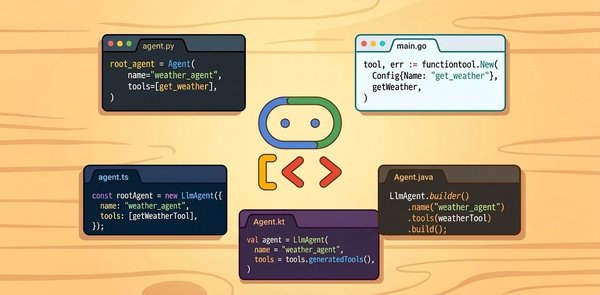
The clearest way to feel the difference between the five languages is to define the same weather tool in each one and see how its design fits the runtime.
Cryptographic Security & Key Generator
Generate entropy-tested high-security keys and encryption-grade tokens.
Source: Cloud Blog.
Read the full story at the original source ↗
For questions: mrsmithcons@gmail.com.
More from FreeSky Cloud