Introducing enhanced custom event buses in Amazon EventBridge for enterprise-scale event-driven applications
Story summary
Amazon EventBridge announces an enhanced custom event bus for organizations scaling event-driven applications across teams and accounts. Deploy a single event bus shared across all AWS accounts in your organization, with ordering guarantees, a simplified Subscriber resource, and improved economics a
📌 Key Highlights & Takeaways
- Amazon EventBridge announces an enhanced custom event bus for organizations scaling event-driven applications across teams and accounts.
- Deploy a single event bus shared across all AWS accounts in your organization, with ordering guarantees, a simplified Subscriber resource, and improved economics a
Organizations building event-driven applications on Amazon EventBridge typically start with a single custom event bus in one account. This works well when a single team owns the architecture. As adoption grows across the organization, though, things get complicated. AWS best practices recommend a multi-account structure, which means each team runs in its own account. To route events between them, teams create multiple event buses connected through cross-account rules or bus-to-bus configurations. This workaround reintroduces the operational complexity that serverless architectures are meant to eliminate. Platform teams lose visibility into who is subscribing to which events, cross-account and bus-to-bus routing charges compound quickly, and teams that need capabilities like event ordering are forced to build complex workarounds or adopt entirely different technologies.
Today, we are announcing an enhanced custom event bus in Amazon EventBridge, purpose-built for organizations scaling event-driven applications across teams and accounts. With the new enhanced custom event bus, you can deploy a single, centralized event bus shared across all AWS accounts in your organization, with ordering guarantees, a simplified Subscriber resource, and a new pricing model that delivers improved economics at scale and cost allocation for publishers and subscribers.
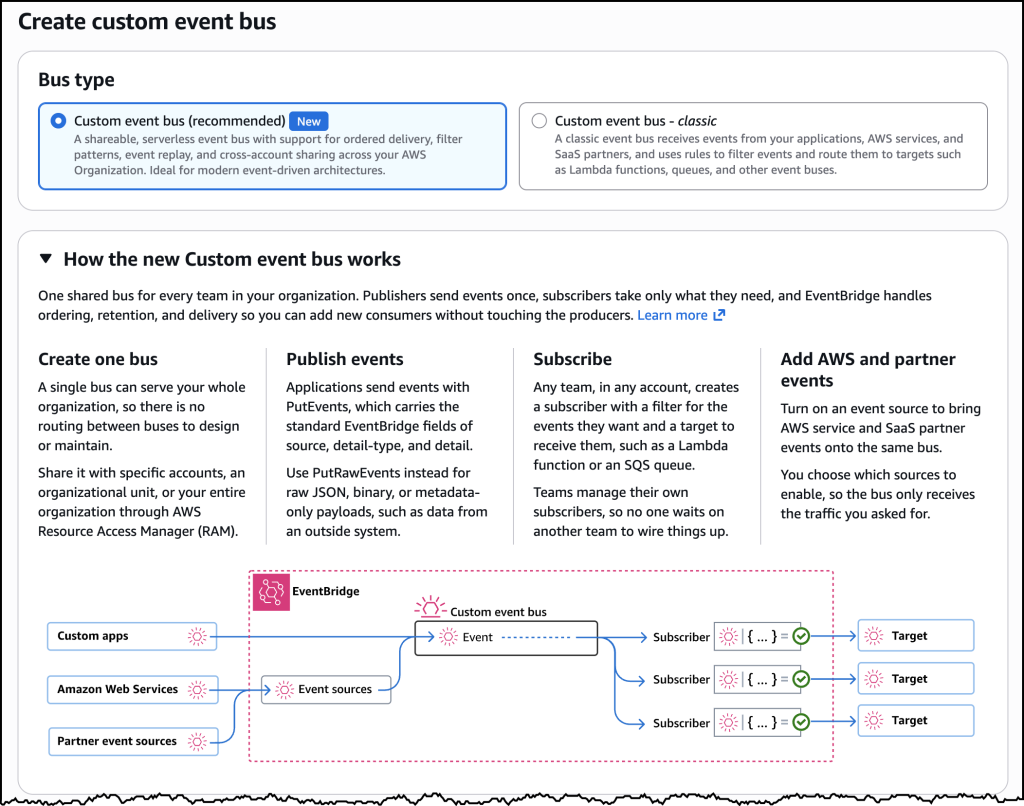
Let’s try it out To get started with an enhanced custom event bus, I navigated to the EventBridge console in the AWS Management Console and opened the Create custom event bus page. I selected Custom event bus, the recommended option labeled New. The page also offered Custom event bus – classic, which continues to receive events and route them with rules and targets. Below the selection, EventBridge showed how the new bus works. One shared bus serves every team in the organization. Publishers send events, subscribers consume only what they need, and EventBridge handles ordering, retention, routing, and delivery.
The Create custom event bus page. Custom event bus is the recommended new option, with ordered delivery, filter patterns, event replay, and sharing across your AWS organization. Custom event bus – classic remains available for existing workloads.
Next, I configured resource sharing. I turned on Enable event bus sharing and selected Allow sharing only within your organization. I chose AWS account ID as the principal type. I could also share with an organization, an organizational unit, or an AWS Identity and Access Management (IAM) role or user. Sharing uses AWS Resource Access Manager (AWS RAM) , so I did not have to set up cross-account permissions or bus-to-bus routing myself.
Resource sharing on the new custom event bus. I enabled sharing within my organization through AWS RAM and selected an AWS account as the principal, which is how teams publish and subscribe on the same bus without extra routing.
Organization-wide sharing With the new enhanced custom event bus, you can create a single event bus and share it across all AWS accounts in your organization. Platform teams deploy one bus and establish it as the central event backbone, eliminating the need to configure cross-account permissions or bus-to-bus routing. Application teams across your organization can publish and subscribe to events on the same bus without waiting for infrastructure provisioning.
Publishers send events without needing to know which teams consume them, and subscribers create their own Subscriptions independently. Platform teams maintain visibility into all event flows and fine-grained control over who can publish and consume events. The new enhanced custom event bus has a default quota of 10,000 Subscribers per bus, and you can request a higher quota. That reduces the fragmentation that occurs when subscriber limits force you to split across multiple buses.
Cryptographic Security & Key Generator
Generate entropy-tested high-security keys and encryption-grade tokens.
Source: AWS News Blog.
Read the full story at the original source ↗
For questions: mrsmithcons@gmail.com.
Unlock Up to $10,000 in Free AWS, GCP & Azure Credits for Builders and Developers
The developer portal for modern cloud infrastructure: claim free cloud credits, discover generous free-tier developer tools, and optimize DevOps pipelines.
Claim Cloud Credits ➔☁️ Complete Cloud Credit Application Guide & Architecture Specs
Direct application templates, fast-track partner codes, and architecture benchmarks.
⚡ Access Cloud Playbook ➔More from FreeSky Cloud



AI Agent Wars: Why Big Tech Keeps Spending + The HBM4 Showdown — Samsung vs SK Hynix!
Curious about the latest drama in big tech, AI, and semiconductors? We dive into the tech turf war, what’s hot...
 🍿 CosmoCinema 998
Call of Duty: Black Ops 7 x DOOM - Official Event Pass Trailer
Call of Duty: Black Ops 7 x DOOM - Official Event Pass Trailer...
 🤖 WinBar AI
Massachusetts: Gaming regulators to evaluate AI use in sports betting
Breaking coverage reported by CDC Gaming: Massachusetts: Gaming regulators to evaluate AI use in sports bettin...
Amazing Top 5 Brushless FPV Quadcopters For Beginners You Need To See - L900 Pro SE MAX GPS Drone 4K Professional Dual H...
Best Top 5 Brushless FPV Quadcopters For Beginners deals on AliExpress: 1. New L600 Pro MAX 4K Professional Dr...